Wool is one of humanity’s oldest companions. Long before there were factories or synthetic materials, people discovered that the fleece of sheep and certain other animals provided warmth, durability, and versatility that plant-based fibers simply could not match. Today, despite the enormous variety of man-made alternatives, natural wool remains irreplaceable for those who understand its true character.
At the most basic level, wool is a protein fiber, chemically composed primarily of keratin — the same protein that forms human hair and nails. Under a microscope, each wool fiber looks like a tiny shaft covered in overlapping scales, similar in structure to roof tiles. These scales are what give wool its unique ability to felt and to grip — when fibers are agitated in warm water, the scales interlock, which is both the cause of wool’s tendency to shrink and, when controlled deliberately, the process behind felted wool products.
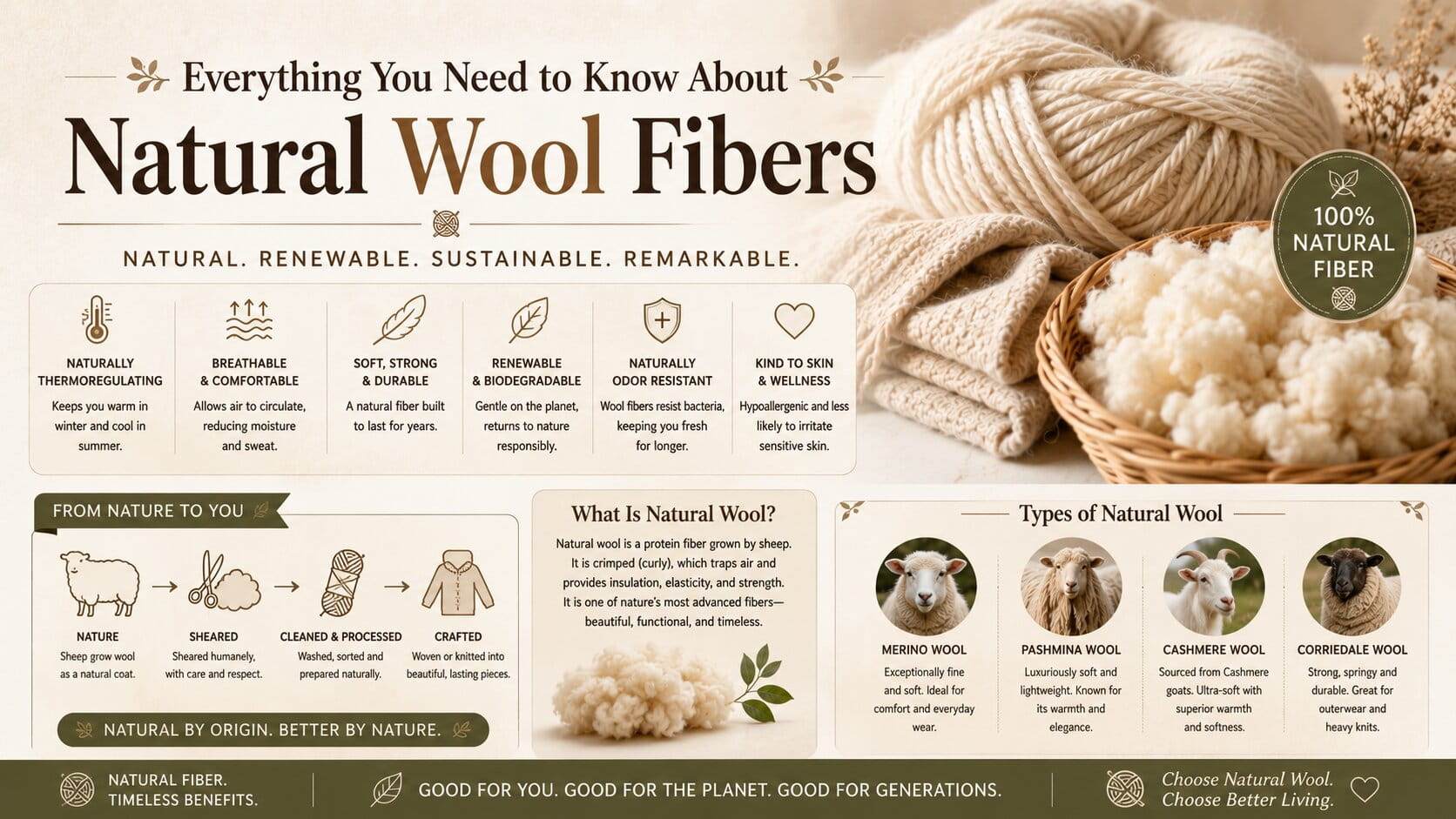
The quality and character of wool varies enormously depending on the source. Merino sheep, originally from Spain but now most famously raised in Australia and New Zealand, produce some of the finest commercially available wool, with fiber diameters consistently below 20 microns. Shetland sheep from Scotland produce a slightly coarser wool that is exceptionally durable and warm. Bluefaced Leicester sheep produce long, lustrous fibers ideal for fine knitting yarns. Rambouillet, Corriedale, and Targhee are other breeds prized for different qualities.
Beyond sheep, there are several other animals whose fiber is classified under the broad umbrella of wool or wool-like luxury fibers. Cashmere comes from the undercoat of Cashmere goats. Angora comes from Angora rabbits — incredibly soft but requiring careful handling. Mohair comes from Angora goats and is known for its silky sheen. Alpaca, which is technically not wool but often discussed alongside it, produces extremely fine, hypoallergenic fiber that lacks the natural lanolin of sheep’s wool.
Lanolin deserves its own mention. This natural grease produced by wool-bearing animals is present in raw wool and is partially retained even in processed yarn. It acts as a natural water repellent and has been used in skin care and cosmetics for centuries. Many people with dry or sensitive skin find that wool garments feel soothing rather than irritating, partly because of residual lanolin.
The processing of wool from raw fleece to finished yarn involves multiple steps: shearing, sorting, scouring (washing), carding or combing to align the fibers, and spinning. Each step affects the final character of the yarn. Woolen-spun yarn, where fibers are only loosely aligned, creates lofty, airy fabric. Worsted-spun yarn, where fibers are carefully combed parallel to each other, creates a smoother, denser, more durable fabric.
Understanding wool at this level transforms how you shop, how you care for your garments, and how much you appreciate the extraordinary natural material that has clothed humanity across continents and millennia.