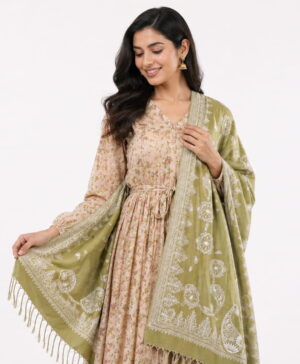
If you have spent any time shopping for high-quality shawls or wraps, you have almost certainly encountered three terms used sometimes interchangeably, sometimes with great ceremony: pure wool, pashmina, and cashmere.
Are they the same thing?
Are they completely different?
The short answer is — it is complicated, and the distinctions matter quite a lot when you are about to spend good money.
Pure Wool
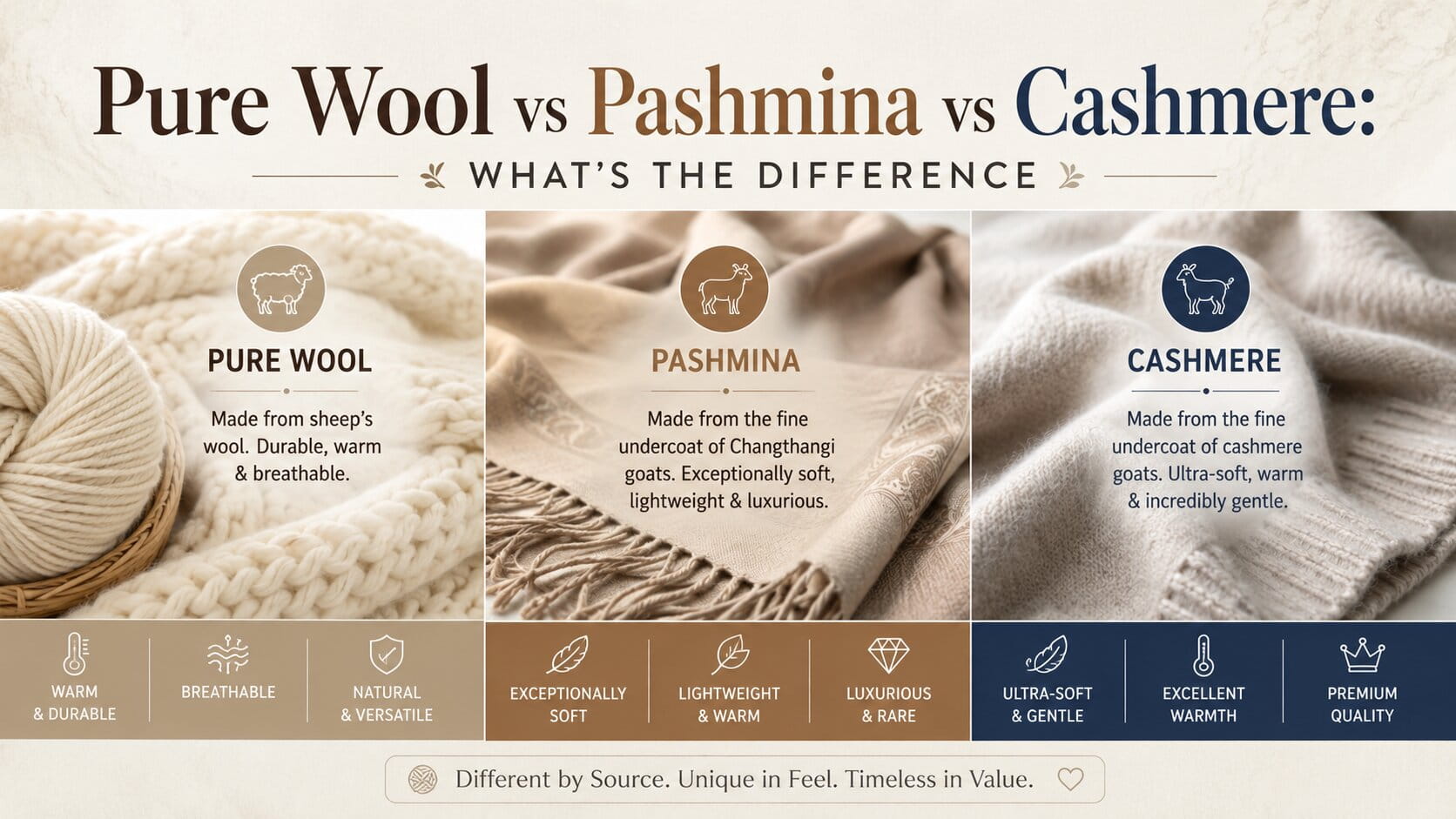
Let us start with pure wool, the broadest of the three categories. Wool is the natural fiber shorn from sheep, and it comes in a wide variety of grades and textures depending on the breed. Merino wool from Australia and New Zealand is known for its fine, soft fibers. Lambswool, taken from a sheep’s first shearing, is particularly soft. Regular wool from older animals tends to be coarser. All of these are technically “pure wool” — the term simply means the fiber comes from sheep and has not been blended with synthetics.
Cashmere
Cashmere steps things up considerably. It comes not from sheep but from cashmere goats, specifically the soft undercoat that these animals grow to survive harsh winters in regions like Mongolia, China, and parts of Central Asia. The fibers are measured in microns, and top-quality cashmere typically falls between 14 and 16 microns — extremely fine. This fineness is what gives cashmere its legendary softness. The animals produce a limited amount of this undercoat each year, which is why genuine cashmere is expensive.
Pashmina
Pashmina is where things get genuinely fascinating. The word comes from “pashm,” the Persian and Urdu word for the ultra-fine wool of the Changthangi goat, a breed that lives on the high-altitude Changthang plateau of Kashmir and Ladakh. True pashmina fiber is even finer than standard cashmere — around 12 to 14 microns — and the collection process is entirely traditional. Herders comb the fiber by hand from the goats during spring, when the animals naturally shed. There is no shearing involved.
The tragedy is that the word “pashmina” has become badly abused in global retail markets. Walk into almost any tourist market and you will find shawls sold as “pashmina” that contain not a single strand of actual pashm. These are often viscose, acrylic, or low-grade wool. The real thing is rare, produced in limited quantities, and carries a price that reflects its scarcity and the labor involved.
From a practical standpoint, all three — wool, cashmere, and true pashmina — offer excellent warmth relative to their weight. Wool is the most durable and easiest to care for. Cashmere is noticeably softer but requires more careful handling. Pashmina, at its finest, is extraordinarily lightweight and warm, and when woven by traditional Kashmiri craftspeople, represents one of the most refined textile achievements in the world.
If someone offers you a “100% pashmina” shawl for a very low price, it is almost certainly not what they claim. Real pashmina is a luxury, not a bargain. Understanding these distinctions protects you as a buyer and also supports the artisans and communities whose livelihoods depend on preserving these craft traditions.