Walking into a store or browsing an online catalogue, you are immediately confronted with labels that say things like “wool blend,” “wool-like feel,” or “100% pure wool.” The problem? Not all of these claims hold up to scrutiny. In a market flooded with synthetic imitations, knowing how to tell real wool from the fake stuff is one of the most valuable skills a shawl buyer can develop.
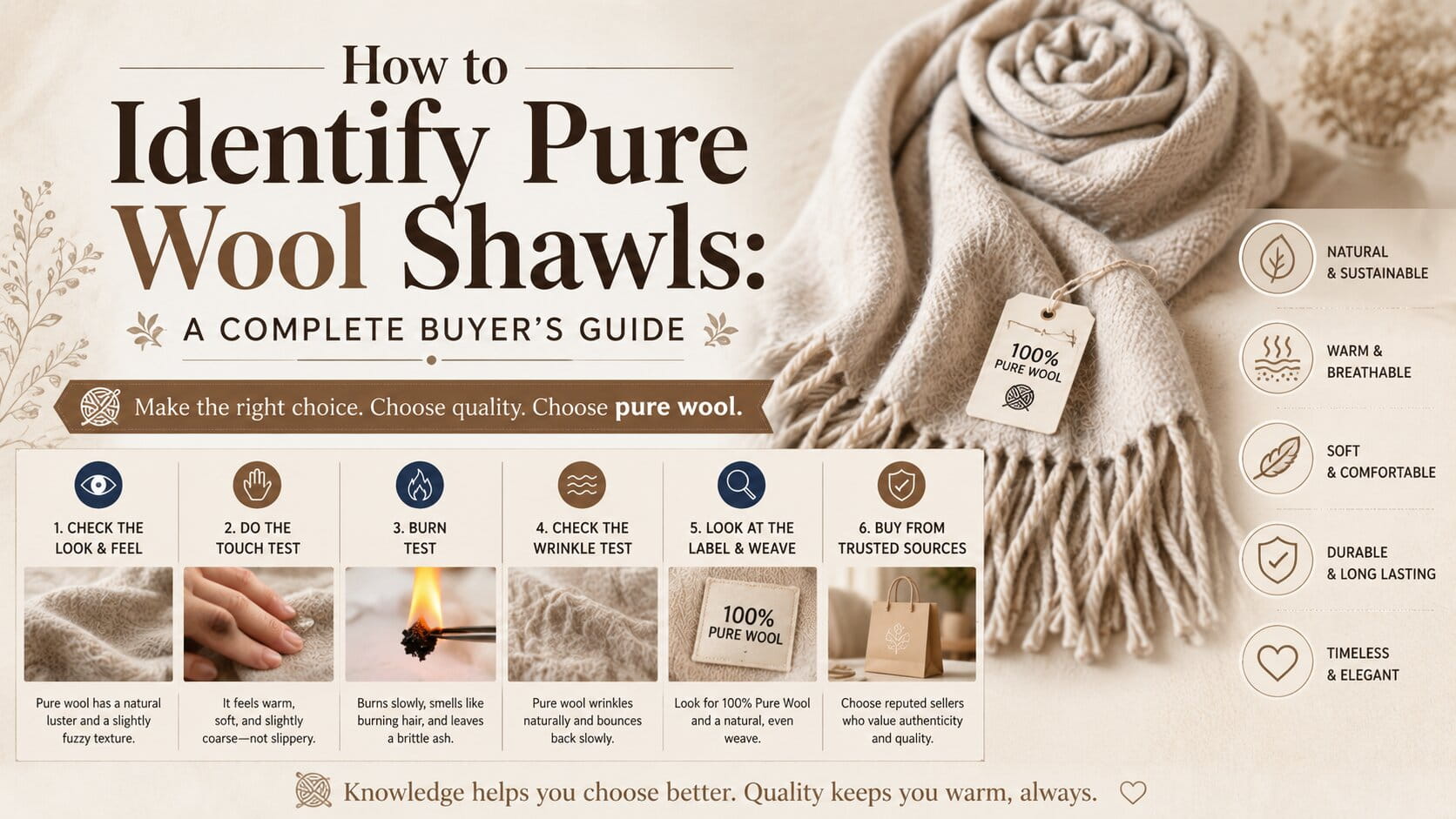
The first and most reliable test you can do at home is the burn test. Pull out a few loose fibers from the edge of the shawl and hold a flame to them. Pure wool burns slowly, smells like burning hair or singed feathers, and the ash crumbles easily when touched. Synthetic fibers behave very differently — they tend to melt, drip, smell like burning plastic, and leave behind a hard, bead-like residue. This single test can save you from a lot of expensive mistakes.
Next, pay attention to how the fabric feels in your hands. Pure wool has a natural warmth and a slight resistance when you press it — it pushes back softly, almost as if it is alive. Synthetic blends, no matter how cleverly designed, tend to feel either too slippery or too stiff. Real wool also has a natural texture; those tiny scales on each fiber give it a very faint grip that man-made materials simply cannot replicate.
Look closely at the weave. Handwoven wool shawls will almost always have slight irregularities — threads that vary microscopically in thickness, tiny loops, or even the odd knot where a new thread was joined. This is not a flaw; it is proof of the human hand behind the work. Machine-made fabrics, including those made from wool, tend to have a uniform, almost mechanical regularity that trained eyes can spot immediately.
Labels are your next clue, but you need to read them carefully. In many countries, a fabric can be labelled “wool” even if it contains as little as 30 to 50 percent actual wool fiber, with the rest being synthetics. Look for labels that specifically say “100% pure new wool” or “100% virgin wool.” The word “new” or “virgin” means the wool has not been recycled or repurposed from old garments, which matters for quality.
Price is not always a reliable indicator, but it is still worth considering. Genuine pure wool shawls require shearing, cleaning, spinning, dyeing, and either hand-weaving or careful machine processing. That adds up. If a shawl is being sold at a price that seems impossibly low for the supposed quality, trust your instincts and ask more questions.
When buying online, do not hesitate to ask the seller direct questions: Where was the wool sourced? Which region or breed of sheep does it come from? Is it hand-woven or machine-made? A seller who truly knows their product will be happy to answer these questions in detail. Vague or evasive responses should raise a flag.
Finally, buy from sellers with a solid reputation and clear return policies. Pure wool shawls are a genuine investment, and reputable sellers know that. They will often provide certificates of authenticity, detailed product descriptions, and have reviews from previous buyers who can confirm the quality they received.